

Your Hot Tub Is Not Heating, But Everything Looks Fine
Few things are more frustrating in cold weather than a hot tub not heating when everything else seems to work. The control panel responds, the pump runs, and the jets circulate water, yet the temperature refuses to rise. There’s no error code to explain what’s wrong.
Before assuming an expensive repair is necessary, consider that the heater may be shutting itself off as a safety precaution. Temperature sensors and safety switches can prevent heating when operating conditions aren’t right, sometimes without displaying a warning.
The problem could involve restricted water flow, incorrect settings, or a faulty sensor rather than a failed heating element, regardless of outdoor temperatures. Identifying the underlying cause is the first step toward restoring heat.
Key Takeaways:
- A hot tub that won’t heat is often protecting itself, even when the pump, jets, and control panel look normal.
- Heating needs permission as well as hardware: the wrong heater mode or a low set temperature blocks heat with no error shown.
- Dirty filters, low water, an airlock, or a faulty flow switch cut off circulation before anything looks wrong.
- Tripped GFCIs, blown fuses, and high limit switches cut power quietly while the rest of the spa keeps running.
- Scale buildup, poor water chemistry, and a worn cover stress the system before any single part fails.
Why Is Your Hot Tub Not Heating When Nothing Looks Broken?
A hot tub heater rarely fails in an obvious way. The panel still responds, the pump runs, and the tub looks perfectly fine from the outside. Most heating issues are intentional shutdowns built into the system, not mechanical breakdowns, and the two look identical until you know what to check.
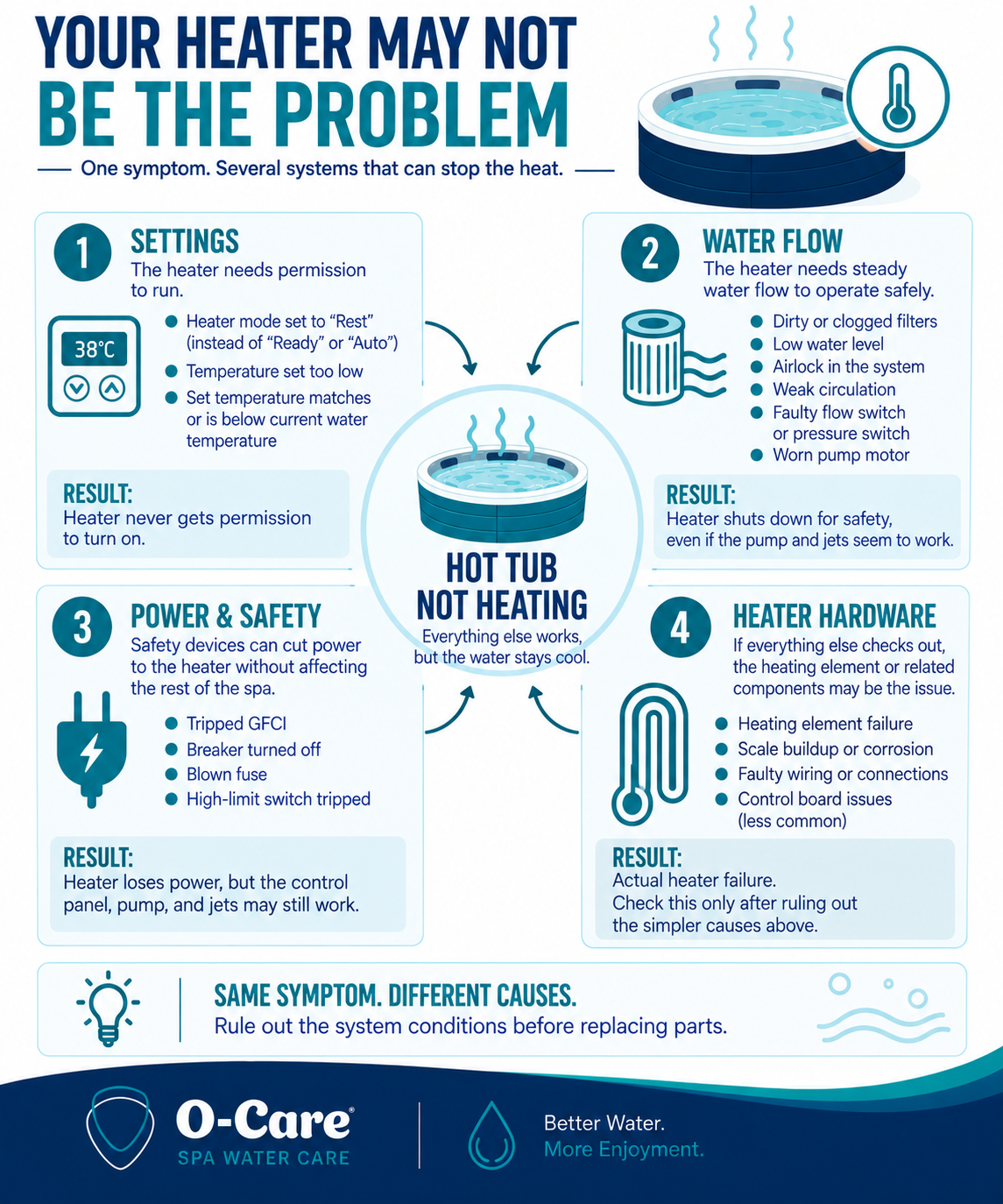
Most hot tubs stop heating for a short list of reasons: a fault with the heating element, hot tub pump issues, or a thermostat that never gave the heater permission to run. Miss one, and the system deliberately blocks heat.
Is Your Hot Tub Actually Allowed to Heat Right Now?
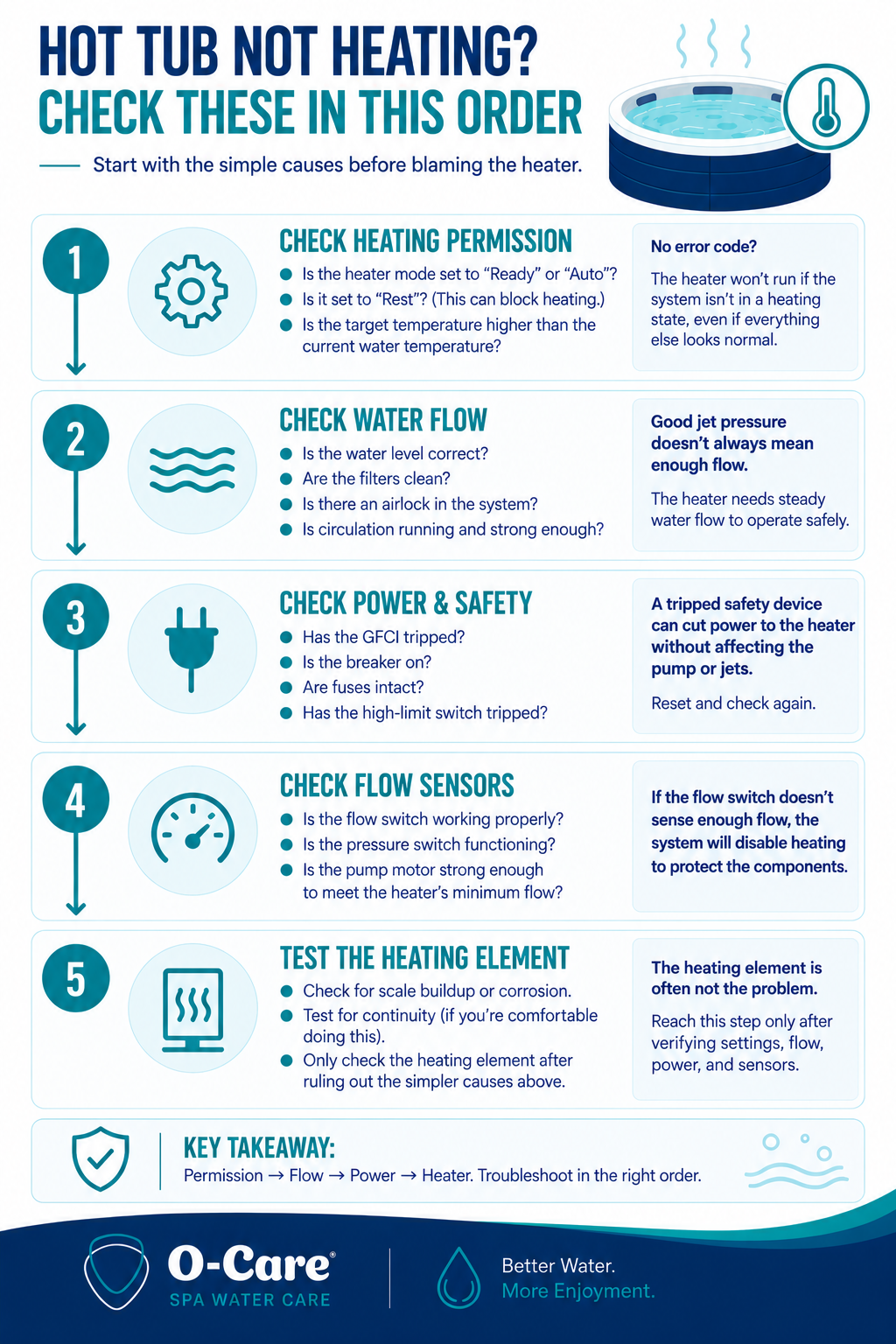
Before assuming a failed part, check whether the system is even permitted to heat right now. Plenty of “broken” hot tubs are, in fact, not in a heating state at all, and no amount of troubleshooting the heater itself will fix a permission setting.
This comes down to two quiet settings:
- The heater mode should be set to “Ready” or “Auto”, not “Rest”, for optimal heating.
- The thermostat setting must be higher than the current water temperature for the heater to activate.
If the target temperature matches or falls below the actual water temperature, the system has no reason to heat; the heater is doing exactly what it was told. Nudge the thermostat a degree or two above the current reading; that’s the whole fix.
Why Does Water Flow Stop Heating Long Before Anything Breaks?
Heating depends on stable water flow, not only on whether the pump runs or the jets feel strong. When flow conditions aren’t safe, the system disables heating quietly to protect the components underneath, well before anything looks visibly wrong to the owner.
A few causes explain most of it:
| Flow-related issue | What happens internally |
| Dirty filters, low water levels, or an airlock | Low water flow can be caused by dirty filters, low water levels, or airlock, reducing circulation through the heater |
| Insufficient circulation | The heater relies on sufficient water flow to operate correctly |
| Faulty flow switch or pressure switch | A broken flow switch stops reading proper water flow and shuts down the heater even when flow is fine |
| Worn pump motor | A tired pump motor can’t move enough hot tub water to satisfy the heater’s minimum flow |
Water can still move through the plumbing and the pump can sound normal. Inside the system, heating is already disabled because a flow switch issues no confirmation of safe circulation.
Read more: Parts of a Hot Tub: Understanding Key Components
Why Are Dirty Filters the Leading Cause of Hot Tub Heating Problems?
A hot tub not heating looks like a heater failure the moment you notice it. Filters are usually the first real cause, though, even when the rest of the system looks completely normal and nothing on the panel says otherwise.
Clogged filters restrict flow enough to block the heater without ever showing hot tub error codes: debris reduces flow, flow blocks heating, and the tub runs without building heat.
Replacing or cleaning filters usually restores heating without touching the heater at all. Regular cleaning is what most of these calls actually need, not a replacement heater.
How Can Low Water Levels Quietly Disable the Heater?
A hot tub doesn’t need to look empty to stop heating. Sensors detect unsafe water levels and block the heater before damage occurs, and the gap between “looks full” and “enough to circulate safely” is smaller than most owners assume.
During filling, an air pocket or a level an inch short can interrupt circulation, with no warning on the panel first. Verifying water level against the correct water level line on the shell is the fastest way to rule it out.
Why Do Airlocks Stop Heating After Refilling a Hot Tub?
An air lock forms right after filling, trapping air inside the plumbing and pipes. Water can’t move through the system the way it should, and the heater treats that the same as any other flow problem: it refuses to run.
Hot-tub airlocks disable the heater even while the pump runs, with no leak, noise, or visible sign of the air trapped inside the lines. Bleeding it out, by turning jets on and off in short bursts to release trapped air pockets, is what actually clears it.
What Are Error Codes Like FLO or HL Actually Telling You?
Error codes on the panel look like a clear diagnosis. Codes like FLO or HL describe a condition the system is detecting in the moment, not always a failed part, and reading them correctly saves a lot of guesswork before you touch anything.
FLO points to water flow, HL to overheating; both are errors, not diagnoses. FLO points to restricted water flow; HL or OH points to overheating or a high-limit shutdown. Check the exact code in your owner’s manual.
Read more: When a Hot Tub Shuts Itself Down for “Safety”: Hot Tub Error Codes (2026 Guide)
When Is the Heater Fine, but Power Is Not?
A hot tub can stop heating with a completely intact heater, because power is being limited or cut somewhere upstream for safety. Electrical protection steps in long before any real damage shows, and it doesn’t ask permission before it does.
A small set of checks covers it: a mismatched electrical supply, a blown fuse cutting off high voltage electricity, or a GFCI/breaker tripped on a power spike whose safety systems lock it out until reset. Check every breaker is on.
Read more: Essential Hot Tub Electrical Requirements for Safe Installation
What Is the Small Red Button Most Owners Miss?
A tripped high limit safety switch stops plenty of hot tubs from heating without any warning at all. The reset button is usually a small red button on the control pack; check your manual. Turn off power at the breaker first before anyone opens the equipment bay.
High limit switches can malfunction on their own and point out high limit errors, feeding the control board or circuit board an inaccurate reading that trips a shutdown for no real reason. Look for the reset button near the heater and press it, even with no error showing.
When Is the Heating Element Actually the Problem, and How Long Should It Last?
A failed heater element is less common than a flow issue or a setting problem, but the diagnosis is clearer once it happens. A working element typically reads resistance; anything outside the recommended range points to element failure.
Scorching or damage on the element means the fault outlasts a reset. Most heating elements last five to seven years; scale buildup and chemical imbalance, not routine wear, cut that short. No power reaching it, or damage on the wires, means replacement. Inspect the heating element for visible damage regularly.
Why Do Water Chemistry and Maintenance Affect Heating More Than the Heater Itself?
Heating problems aren’t always mechanical. Poor water chemistry, scale buildup, and heat loss from a worn cover wear the system down long before any single part fails outright, and by the time the heater actually quits, the real damage has usually been building for months.
Proper water chemistry, a pH balance of 7.2 to 7.8, keeps scale off the heating element and slows the corrosion that eventually kills it. A waterlogged cover works against that same goal, letting heat escape and forcing the system to work harder without the temperature climbing.
The same chemicals sold to keep the water clear often grind away at the equipment underneath. Sanitizer swings and scale stress the pump, the heater, and the jets pushing through it every day. Regular maintenance, including a scheduled drain and refill hot tubs every six months for quality, helps prevent water chemistry from drifting far enough to matter.
O-Care’s mineral salts work against that cycle, preventing scale at the source instead of dosing around it, .and preventing scale is one less thing working against your heater.
When Does DIY Stop Being the Right Move?
Some hot tub heating issues cross the line from simple checks into real electrical risk. That’s exactly the point where DIY troubleshooting should stop and a licensed professional takes over, before a small mistake turns into a genuinely dangerous one.
Power off the spa first. If a basics check still leaves the tub cold, that’s a multimeter job, testing the heating element and high limit sensor for continuity. Past that point, professional repair beats professional help after a mistake.
Read more: Parts of a Hot Tub: Understanding Key Components
Conclusion: A Hot Tub That Won’t Heat Is Usually Protecting Itself
A hot tub not heating usually isn’t a breakdown. It’s the hot tub’s heating system protecting itself when water, flow, or safety conditions aren’t right, even while everything else keeps running like nothing is wrong. Check permission and flow first, then power, then the element, in that order.
Treat it as a water-care and system-stability problem rather than a parts problem, and the fix tends to actually stop repeating. Our hot tub maintenance guide covers what to stay on top of so the same shutdown doesn’t keep finding its way back to your tub.
Simplify your hot tub maintenance with O-Care Comfort. Discover how it helps keep your water clean, balanced, and comfortable with less effort.


